How to figure out your car payment: the formula, the calculator, and the spreadsheet

Quick answer
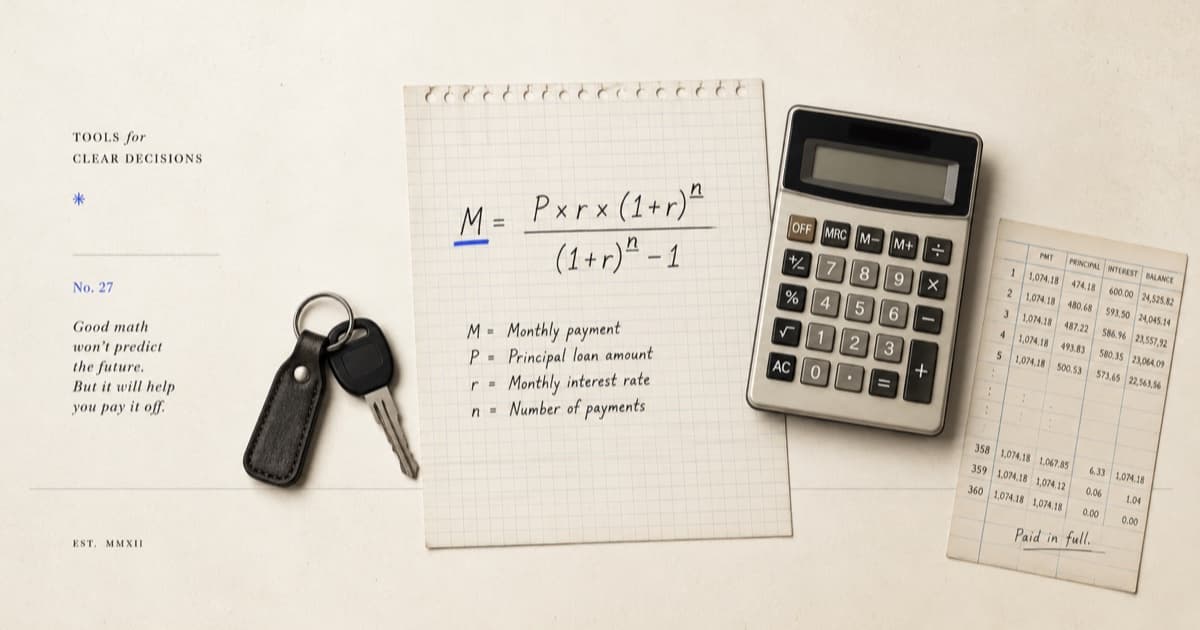
Figuring out a car payment takes three numbers: the loan amount (sticker price minus your down payment and trade-in), the APR your lender quoted, and the term in months. Feed them to the amortization formula M = P × r × (1 + r)n / ((1 + r)n − 1)and the monthly payment falls right out. Don’t feel like doing algebra at the dealership? Let the auto loan calculator handle it. Type the three numbers, read the answer.
What goes into a car payment?
Strip away the showroom theater and a monthly payment on a standard auto loan comes down to exactly three numbers:
- Loan amount (P). The price of the car afteryour down payment, trade-in, and any rebates, plus any sales tax, title, and registration fees you’re rolling into the financing. This is the dollar figure you’re actually borrowing.
- APR. The annual percentage rate the lender quoted you. For car loans this is almost identical to the interest rate (more on that below). It comes from your credit score, the term, and whether the car is new or used.
- Term (n).How many monthly payments you’ll make. Common car-loan terms are 36, 48, 60, 72, and 84 months, which works out to 3, 4, 5, 6, and 7 years.
Things that don’ttouch the loan payment but absolutely show up on your bank statement: insurance, fuel, maintenance, parking, tolls. Those ride alongside the payment in your budget, not inside it. When somebody calls a $400 payment “cheap,” they’ve usually forgotten the other $300 to $500 the thing quietly siphons off every month. A car is a money pit with cupholders. Plan for the whole pit.
Three ways to figure out your car payment
There are three ways to turn those numbers into a monthly figure. They all land on the exact same answer, so pick the one that fits what you’re actually doing.
| Method | Time | Setup | Best for |
|---|---|---|---|
| 1. Auto loan calculator | ~30 seconds | None | Comparing scenarios at the dealership |
| 2. Amortization formula by hand | 2–5 minutes | Any calculator with a power button | Understanding what the calculator did |
| 3. Spreadsheet PMT function | 1 minute | Excel, Google Sheets, or Numbers | Modeling many scenarios side-by-side |
Method 1 is the right default. Same math as the other two, just wearing a nicer outfit. Do Method 2 by hand once in your life so you know exactly what the calculator is up to under the hood, and so no finance manager can fast-talk you. Method 3 is what I reach for when five financing offers are on the table and I want them lined up on one screen, no squinting.
Method 1: Use the auto loan calculator (30 seconds)
The fastest way to figure out your car payment is to type the three inputs into a calculator and read the answer back. Nothing to install, no formula to memorize, no exponent buttons to fumble.
- Open the calculator. Go to the auto loan calculator. It opens with sensible defaults for a car loan ($30,000, 7.5% APR, 5 years).
- Enter your three numbers. The loan amount (price minus down payment), the APR your lender quoted, and the term in years. The monthly payment, total interest, and total amount paid update live as you type.
- Compare scenarios. Bump the term up a year, or throw another $2,000 at the down payment, and watch the payment and total interest both move. That little tug-of-war is the whole game. Make it before you sign, not after.
Under the hood it’s running the exact amortization math the rest of this post walks through, just a whole lot faster than you and a calculator. Shopping a mortgage, a student loan, or a personal loan instead? The same engine drives the main loan calculator.
Method 2: The car payment formula (by hand)
Here’s the standard amortizing-loan formula, the one every car payment calculator (ours included) is quietly solving for you. Learn it once and you can sanity-check any quote a dealer slides across the desk, which is a surprisingly satisfying party trick.
M = P × r × (1 + r)^n / ((1 + r)^n − 1)

P = loan amount (the dollars you're borrowing)
r = monthly interest rate (APR ÷ 12 ÷ 100)
n = number of monthly payments (years × 12)
M = monthly payment
Let’s run a real one: a $30,000 auto loan at 7.5% APR for 5 years (60 months).
- Convert APR to a monthly rate. r = 7.5 ÷ 12 ÷ 100 =
0.00625. - Raise (1 + r) to the n. (1.00625)60 =
1.45329. - Numerator. P × r × (1 + r)n = 30000 × 0.00625 × 1.45329 =
272.49. - Denominator. (1 + r)n − 1 = 1.45329 − 1 =
0.45329. - Divide. M = 272.49 ÷ 0.45329 =
$601.14per month.
Add it up: 60 × $601.14 = $36,068.31 over the life of the loan. Knock off the $30,000 you actually borrowed and you’ve handed the bank $6,068.31 in interest for the privilege. Punch the same three numbers into the car loan calculatorand you’ll get the same figures to the penny. That’s the formula at work, minus the hand cramp.
Method 3: In a spreadsheet (Excel, Google Sheets, Numbers)
Every modern spreadsheet ships with a PMT function that runs the formula above so you don’t have to. I spent the better part of a decade living inside =PMT() at an oil-and-gas firm, so trust me on this one. It wants the rate per period, the number of periods, and the loan amount as a negative number, so the payment comes back positive. (That last bit trips up everybody the first time.)
=PMT(rate/12, months, -principal)

Example: $30,000 loan, 7.5% APR, 60 months
=PMT(0.075/12, 60, -30000)
Result: 601.14
Park the rate, term, and principal in three cells and point the PMT call at them. Now you can poke any input and the payment recomputes on the spot. Stack a few rows (60-month vs. 72-month, 6% APR vs. 9%) and you’ve built the apples-to-apples comparison the finance manager would really rather you didn’t. That’s usually the moment the “low” monthly payment stops looking so friendly.
Real car payment examples
Nothing builds intuition like a few real numbers. The table below runs the amortization formula across realistic 2026 auto-loan rates. Same math the calculator uses, no thumb on the scale.
| Loan amount | APR | Term | Monthly payment | Total interest |
|---|---|---|---|---|
| $20,000 | 6.0% | 48 mo (4 yr) | $469.70 | $2,545.63 |
| $30,000 | 7.5% | 60 mo (5 yr) | $601.14 | $6,068.31 |
| $45,000 | 8.0% | 72 mo (6 yr) | $789.00 | $11,807.70 |
| $60,000 | 9.0% | 84 mo (7 yr) | $965.34 | $21,088.95 |
Two things jump out. First, every point of APR is real money. On the $30,000 / 60-month row, sliding from 7.5% down to 5.5% saves about $30 a month and roughly $1,700 over the life of the loan, which is a decent chunk of brisket. Second, stretching the term shrinks the monthly payment but fattens the total interest. That bottom row coughs up nearly as much in interest as the second row borrows in principal. Cheaper every month, pricier in the end.
APR vs. interest rate: which one do I plug in?
APR (annual percentage rate) is the interest rate plus any required loan fees, expressed as a yearly percentage. On a car loan there usually aren’t any points or origination fees rolled in, so the APR and the interest rate end up nearly identical, often the exact same number. When they do differ, use the APR. It’s the truer cost of the loan, and it’s what the formula expects. The U.S. Consumer Financial Protection Bureau has a plain-English explainer if you want the regulator’s version.
How to lower your car payment
Five levers actually move the number. Here they are, roughly in order of how hard each one pulls:
- Put more money down. Every $1,000 you put down at 7.5% APR over 60 months knocks about $20 off the monthly payment and saves about $200 in interest. The down payment is the single biggest input you control.
- Shop the loan separately from the car.Pre-qualify with your bank or credit union before you walk into the dealership. Dealer financing is often marked up 1–2 points over the rate you’d get on your own.
- Improve your credit score before applying.Going from a 650 to a 720 credit score can drop your APR by several points on the same car. Pay down revolving balances and don’t open new accounts in the months before you shop.
- Pick a shorter term, carefully. A 48-month loan has a higher payment but dramatically less total interest than a 72-month loan. If the payment feels too high, that usually means the car is too expensive, not that the term is too short.
- Refinance later if rates drop.If you bought when rates were high and they’ve fallen 1.5+ points, refinancing the remaining balance can shave the payment without restarting the clock.
Before you sign a thing, model your numbers on the car loan calculator. Nudge one input at a time and watch the payment react. Same instinct you’d build wrangling Method 3 in a spreadsheet, minus the formula typos.
What’s a “good” car payment?
The rule of thumb everybody quotes is 20/4/10: at least 20% down, finance for no more than 4 years, and keep total monthly transportation costs (payment plus insurance, fuel, and maintenance) under 10% of your gross income. It’s strict, and I’ll be honest, almost nobody hits all three on a shiny new car off the lot. But it’s the rule that keeps your savings from quietly evaporating into a depreciating hunk of metal. Can’t hit all three? Nail two and you’re still on solid ground.
Frequently asked questions
How do I figure out my car payment?
Take the loan amount (sticker price minus down payment and trade-in), the APR your lender quoted, and the term in months, then plug them into an auto loan calculator or the amortization formula M = P × r × (1 + r)^n / ((1 + r)^n − 1), where r is the monthly rate (APR ÷ 12 ÷ 100) and n is the number of monthly payments.
What is the formula for a car payment?
The standard amortizing-loan formula is M = P × r × (1 + r)^n / ((1 + r)^n − 1). P is the loan amount, r is the monthly interest rate (annual APR divided by 12, then divided by 100 to convert from a percentage), and n is the total number of monthly payments. The result M is the fixed monthly payment that pays the loan off exactly at month n.
How do I calculate a car payment in Excel or Google Sheets?
Use the PMT function: =PMT(rate/12, months, -principal). For a $30,000 loan at 7.5% APR over 60 months, enter =PMT(0.075/12, 60, -30000) and the cell returns 601.14, the same answer the formula and the calculator give.
Is APR the same as the interest rate on a car loan?
On most car loans they are almost identical because dealers and banks usually don’t roll points or origination fees into the financing. The APR includes any required fees, so it’s slightly higher than the raw interest rate when those exist. Always plug the APR (not the interest rate) into the calculator, since that’s what gives the true monthly payment.
What’s a good monthly car payment?
A common rule of thumb is 20/4/10: at least 20% down, no longer than a 4-year term, and total monthly transportation costs (payment plus insurance, fuel, and maintenance) under 10% of your gross income. It’s conservative, but it’s what keeps a car from quietly eating your savings rate.
How can I lower my car payment?
Five levers, in rough order of effectiveness: put more money down, shorten or lengthen the term (longer drops the payment but raises total interest), shop the loan separately from the car so the dealer doesn’t mark it up, improve your credit score before applying, and refinance if rates drop after you buy.
Does a longer car loan mean a lower payment?
Yes, but you pay more interest in total. A $30,000 loan at 7.5% APR runs $601 a month for 60 months ($6,068 in interest), or $460 a month for 84 months ($8,652 in interest). You save $141 a month and spend an extra $2,584 on interest. Pick the shortest term you can comfortably afford.
Updated . Written by Wyatt Hutchins.