How many tokens is my prompt? Count them for GPT, Claude, and Gemini

Quick answer
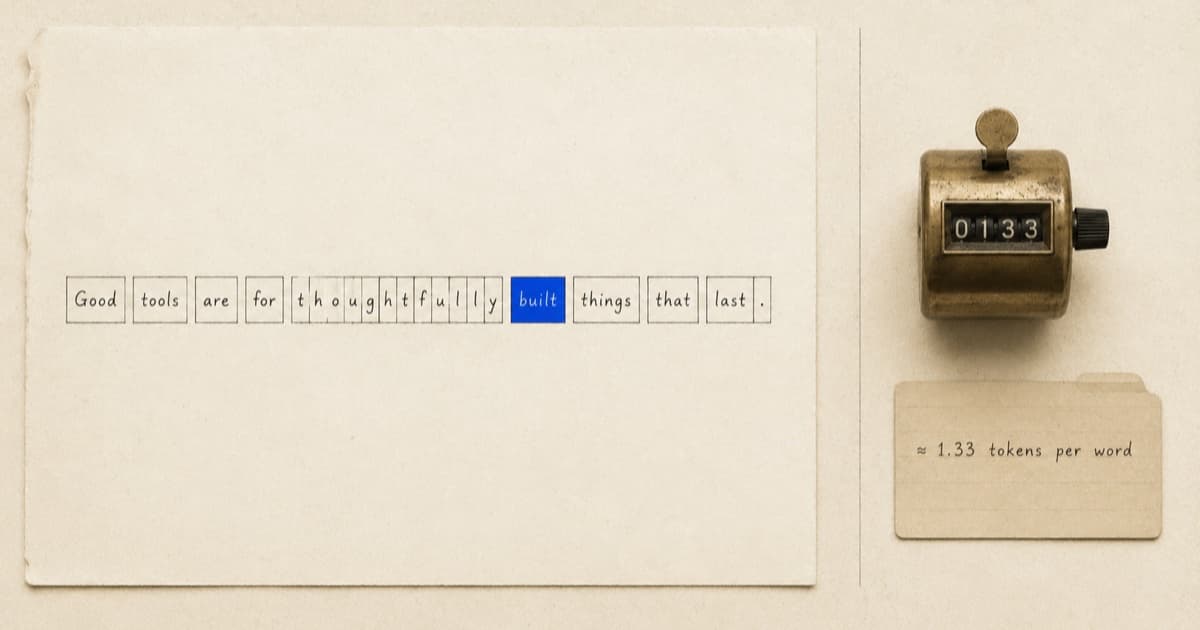
English prose runs about 1.33 tokens per word, or roughly one token per 4 characters. A 1,000-word memo is somewhere near 1,300 tokens. Code, JSON, and Chinese all pack in tighter than that, sometimes a lot tighter. For the real number on your real text, paste it into the new token counter and you get GPT, Claude, and Gemini side by side. It runs in your browser, so nothing you paste leaves your machine.
What a token actually is
Models don’t read words. They read tokens, which are chunks of text that a tokenizer carved out of an enormous pile of writing because those particular chunks kept showing up. Common short words get a chunk to themselves. Rare or long ones get chopped into pieces.
So dog is one token. unbelievable is three or four, depending on whose tokenizer you ask, because un, believ, and able each earned their own slot and the full word never did. Your last name is probably worse. Mine gets sliced into confetti.
A few more quirks that surprise people. A single space between two words is usually free, because the tokenizer glues it onto the front of the word that follows. Long numbers split into groups of about three digits, so a phone number costs more than you’d guess. Punctuation clumps: "}, is frequently one token rather than three. Indentation is real text and gets billed like it. I spent a decade inside spreadsheets where a cell was a cell and that was the end of the discussion. Tokens are not that tidy.
How many tokens is my prompt?
Two rules of thumb get you close on ordinary English. About 4 characters per token, or about 1.33 tokens per word. Pick whichever you can do in your head. The character version is the better of the two, because word count says nothing about how gnarly the words are.
Where those rules fall apart is everything that isn’t plain writing. Here are three real measurements from the free token counter, which is the fastest way to see the spread:
| What you paste | Tokens | Chars per token |
|---|---|---|
| A 500-word blog draft | ≈ 600 | 4.6 |
| A 40-line TypeScript file | ≈ 610 | 3.0 |
| A 200-character Chinese paragraph | ≈ 140 | 1.4 |
Look at the middle row. Forty lines of TypeScript costs about the same as a 500-word essay, and the essay is four times longer to read. Punctuation, brackets, and indentation eat the difference. That’s why dumping a repo into a prompt burns through a context window so much faster than you expect.
The bottom row is the one that catches people shipping to a global audience. Chinese, Japanese, and Korean sit around 1.4 characters per token, so a paragraph that looks short can cost three times what the same meaning costs in English. Same idea, triple the bill.
Chars per token is the number worth watching. Above 4 and you’re writing prose. Around 3 and you’re in code. Under 2 and you’ve left the Latin alphabet behind.
Why GPT, Claude, and Gemini disagree
Every provider trains its own tokenizer on its own vocabulary. The vocabularies overlap a lot, since they all learned from broadly similar text, but they’re not the same list. Feed the identical sentence to three of them and you get three different numbers.
For everyday English the three usually land within about 10% of each other. Using GPT as the baseline, Claude tends to run a touch higher and Gemini sits between them. Those are approximations rather than measurements, and the counter says so plainly: Anthropic and Google don’t publish an offline tokenizer to calibrate against, so anything that claims exact Claude or Gemini counts without calling their API is guessing with confidence.
The gap widens exactly where you’d rather it didn’t. Code, non-English text, weird formatting, long identifiers. And it moves again when a provider swaps tokenizers between model generations, which they do without much fanfare. So don’t budget to the last token. Budget with a cushion and check the invoice.
Will it fit, and what will it cost
Two questions, and most of the time the first one is the urgent one. Context windows now run from 200,000 tokens on the smaller models up to a million on the flagships. A million tokens is roughly 750,000 words of English, call it eight fat novels. Plenty of room, right up until you paste a codebase in.
Cost is simpler arithmetic than people assume. Input pricing lives around $0.20 to $5.00 per million tokens depending on the model. At $5.00 per million, a 10,000-token prompt costs 5 cents. Filling the entire million-token window costs $5. At the cheap end of the lineup that same full window runs 20 cents.
The counter shows input cost only, and that’s deliberate. Your pasted text tells us exactly nothing about how long the answer will be, and output tokens usually bill at several times the input rate. Inventing a response length to pad the estimate with would just be making things up in a nicer font. Prices also move constantly, so every figure carries the date it was last checked against the provider pricing pages. When that stamp goes stale, you’ll know to go look.
The new token counter
Which brings me to the thing this post is actually announcing. There’s a new AI and LLM tools section on Tooligan, and the first thing in it is a token counter.
Paste text into the box and six numbers update as you type: tokens for GPT, tokens for Claude, tokens for Gemini, plus characters, words, and chars per token. All three providers from one pass, so you can see the spread instead of opening three tabs and squinting.
Underneath there’s a model picker covering nine current models across the three families. Choosing one gives you two more numbers: indicative input cost for that model, and what percentage of its context window your text just ate. Go over the limit and it tells you that too, which beats finding out from an API error.
Two things I’ll be upfront about. It’s an estimate, and it says so on every tile. Figure ±10% on English prose, ±15% on code and JSON, ±20% on Chinese, Japanese, and Korean. Close enough to size a prompt or sanity-check a bill, not close enough to settle an argument with your finance team.
The reason for that estimate is the second thing, and it’s the trade I’d make again. Everything runs locally in your browser. Your prompt is not uploaded, not logged, not sent to a provider so a website can tell you how long it is. Half the token counters online will happily take your unreleased draft or your client’s contract in exchange for a number you could have approximated with division. That’s a bad trade.
New toolOpen the token counter →Count tokens for GPT, Claude, and Gemini at once, with context-window fit and input cost. Free, no account, and nothing you paste leaves your browser.When you need an exact count
Estimates are for planning. If a number is going into a bill, a contract, or a hard limit you can’t afford to trip, go to the source. All three providers will give you an exact count:
- OpenAI Tokenizer shows the real split for OpenAI models, token by colored token.
- Anthropic’s count_tokens endpoint returns an exact count for Claude, and it’s free to call.
- Gemini’s countTokens method does the same for Google models.
All three want your text, which is the whole reason they can be exact. Use them when the precision is worth it, and use a local estimate for the other ninety-nine times a day you just want to know whether the thing fits.
The token counter is live now, free, and about as demanding as the unit converter, which is to say it doesn’t want your email either. Go paste something enormous into it and find out what you’ve been sending these models all this time.
Frequently asked questions
How many tokens is my prompt?
For English prose, roughly 1.33 tokens per word, or about 4 characters per token. A 500-word draft lands near 600 tokens. Code, JSON, and non-Latin scripts run denser, so the same character count costs more. Paste the text into a token counter to get a real number instead of doing the arithmetic in your head.
How many tokens is 1,000 words?
About 1,300 tokens of English prose, give or take. The same 1,000 words of dense technical writing, with heavy punctuation, code, or unusual names, will land higher, closer to 1,500. Word count is a rough proxy: character count divided by 4 is usually the better estimate.
Do spaces and line breaks count as tokens?
A single space between two words is usually free, because tokenizers attach it to the word that follows. Anything beyond that costs. Line breaks, tabs, and the indentation in a code file all consume tokens, which is one reason a formatted JSON file can cost noticeably more than the same data with its whitespace stripped out.
Why do GPT, Claude, and Gemini report different token counts?
Each provider trains its own tokenizer on its own vocabulary, so the same sentence splits into different pieces on each one. For ordinary English the three usually land within about 10% of each other. The gap widens on code, non-English text, and unusual formatting, and it can shift again when a provider changes tokenizers between model generations.
How much does a 10,000-token prompt cost?
At $5.00 per million input tokens, 10,000 tokens costs 5 cents. At $0.20 per million it costs a fifth of a cent. Those are input charges only. The model’s reply is billed separately, and output tokens usually cost several times more per token, so a cheap prompt can still produce an expensive answer.
Can I count tokens without uploading my text?
Yes. A character-model estimator runs entirely in your browser, so the text never leaves your machine. The trade-off is that the count is an estimate rather than exact, since an exact count needs either a large tokenizer vocabulary shipped to the page or an API call that sends your text to the provider.
Updated . Written by Wyatt Hutchins.